Installing the Hot-Spark I Electronic Ignition Conversion Kit in Bosch Distributors

Applies to Hot-Spark I (blue, not black) ignition kits

Coil Warning: DO NOT use a low-resistance or an HEI-style coil. Using a coil with less than 3.2 Ohms primary resistance can cause the ignition module to overheat and misfire or fail, and will void the Hot-Spark ignition warranty. DO NOT use an Accel or MSD coil - they don't have enough primary resistance for this application. If using a coil with a bit less than 3.2 Ohms primary resistance, install the included external ballast resistor to increase the total primary resistance to at least 3.2 Ohms. Use 18- or 20-gauge wire between the ballast resistor and the coil’s positive terminal. If in doubt about whether you need to use the ballast resistor or not, go ahead and install it - it can't hurt anything and it may prevent problems down the road.

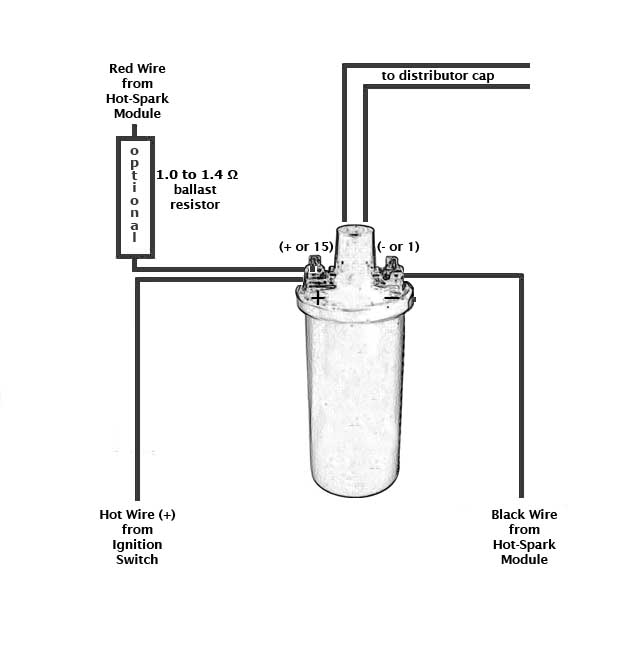
DO NOT reverse the polarity of the red and black wires - it will destroy the ignition module (and void its warranty)! The Hot-Spark module’s red wire connects to positive ( + or 15 on Bosch coil). The black wire connects to negative ( - or 1 on Bosch coil). Remove the condenser and its wire from vehicle.  All other wires are connected to the coil in their original places. This module is designed for 12V negative ground applications only.

Make sure that the ignition wires have plenty of slack inside the distributor and are not rubbing on any moving parts. If you need to extend the length of the ignition wires, use 18- or 20-gauge (AWG) wire. Crimp tightly or solder all connections.


Wiring Diagram: Hot-Spark Electronic Ignition Conversion Kit Schematic for Bosch Distributor

Remove points, condenser and condenser wire from distributor. Remove the condenser and its wire from the vehicle.

Important: Clean the distributor’s breaker points plate thoroughly, so that the ignition module’s base plate makes good thermal contact with the distributor.

Check Charging System Voltage: If your vehicle’s charging system produces more than 13.5 volts at high RPM (3,500+ RPM, measured at coil's positive terminal), we recommend installing an external ballast resistor with about 1.4 Ohms resistance between the hot wire from the ignition switch and the coil’s positive terminal. Or, alternatively, you can install a high-resistance coil (about 3.8 to 4.5 Ohms primary resistance). The extra primary resistance helps to keep the coil and ignition module cool, prolonging their lives and ensuring trouble-free operation. The ballast resistor is usually mounted on the firewall or on or near the coil. Because of the high heat produced by air-cooled engines, we recommend installing a 1.4 Ohm ballast resistor or a high-resistance coil when used with Volkswagen or Porsche. If your vehicle was equipped originally with a resistor wire between the ignition switch and the coil's positive terminal, do not remove it.

If the charging system voltage, measured at the coil's positive terminal, is more than 14.2 volts at 3,500+ RPM, the voltage regulator likely needs replacing. Too much voltage can damage the ignition module.

Make sure that engine oil level is on the full mark before revving engine (air-cooled VW, in particular)!

Air Gap between Magnet Sleeve and Ignition Sensor: BOS4C1 air gap is preset and not adjustable. BOS4V1 air gap should be set at about 0.8 mm (.030 in.).

Ignition Timing: Set the ignition timing, with a stroboscopic light, to the distributor's factory specification. The difference in distributor position with points vs. electronic ignition can be as much as 30 degrees or so clockwise or counterclockwise, so you'll definitely have to reset the timing.


Hot-Spark Electronic Ignition Conversion Kit Installed in Bosch 009 Distributor 

Hot-Spark BOS4C1 Kit in Bosch 0 231 178 009 Centrifugal-advance Distributor

 Hot-Spark BOS4V1 Electronic Ignition Conversion Kit in Hot-Spark SVDA 034 Vacuum-advance Distributor

Hot-Spark BOS4V1 kit installed in Vacuum-advance Distributor

1. Turn off the ignition switch and/or remove the ground strap from the battery. Though not absolutely necessary, it is probably easiest overall to remove the distributor from the car before installing the Hot-Spark module. If the contacts in the inside of the distributor cap are worn or damaged, replace the distributor cap. Replace the rotor if it’s worn.

2. Remove distributor cap, leaving the plug wires in place, unless replacing the distributor cap as well.

3. Remove points, condenser and the condenser's wire from the vehicle. Because the Hot-Spark kit does not modify the distributor, the points and condenser can be reinstalled at a later time.

4. Install the screws that attached the condenser and its grommet back into their holes. If the screws are now too long, use a washer or two on the screws.

5. Clean any grease or dirt thoroughly from the distributor’s points cam and the breaker points plate.

6. Insert the Hot-Spark module’s wires, one at a time, from the inside of the distributor out, through the hole in the side of the distributor. You can use a narrow, flat-bladed screwdriver to gently push the edges of the grommet from the inside of the distributor. Gently pull and rock, up-and-down and side-to-side, the rubber grommet, halfway through the hole, until it seats.

7. Place the Hot-Spark module’s bottom plate onto the distributor’s breaker plate. The peg should fit snugly into the hole in the breaker plate and the screw holes should line up. The Hot-Spark bottom plate should lie flat and snug on the breaker plate. Insert the screw and tighten.

8. Place the magnet sleeve, with the larger opening down, over the distributor shaft. Turn the sleeve left and right while you press it down, until you can feel it begin to seat on the cam lobes. Press down firmly until the sleeve seats all the way down over the cam lobes. When fully seated, the bottom of the magnet sleeve should be flush with the bottom of the Hall sensor’s plastic casing.

BOS4C1: If installing the centrifugal-advance version of the Hot-Spark kit for the 009 or 050 distributor (BOS4C1), don’t worry about setting the gap between the magnet sleeve and the Hot-Spark sensor - it’s preset to a certain gap and not adjustable. There should be sufficient gap to prevent the magnet sleeve from rubbing against the Hot-Spark sensor.

BOS4V1: If installing the vacuum-advance version of the Hot-Spark kit (BOS4V1), next place the Hot-Spark’s top plate over the upright bolts of the bottom plate. The air gap between the Hot-Spark sensor and the magnet sleeve should be set at about 0.8 mm (.030 in.). Place the included washers on the upright bolts, screw the included nuts onto the bolts and tighten snugly with a 7 mm (5/16”) nut driver. Don’t over-tighten these nuts – apply no more than 5 ft. lbs. of torque! Check to see if the vacuum advance is working properly by sucking on the vacuum canister port. The breaker plate should move smoothly and freely.

9. Install the rotor on top of the magnet sleeve. The rotor should slide all the way down and lock into place, so that it cannot turn independently of the distributor shaft. If you can still turn the rotor independently of the distributor shaft, the magnet sleeve is not seated all the way down. Be sure that the indentations inside the magnet sleeve line up with the lobes of the distributor cam - turn the magnet sleeve on the distributor shaft until you can feel it line up. If the fit between the distributor shaft and the magnet sleeve is especially tight and you cannot slide the magnet sleeve down onto the distributor shaft until the bottom of the magnet sleeve is flush with the bottom of the Hall sensor’s plastic casing, you can place a deep-well 14mm or 15mm socket over the end of the distributor shaft and tap very gently on the socket until the magnet sleeve seats firmly onto the distributor shaft, over the distributor cam lobes. Don’t tap too hard or you could break the top off of the magnet sleeve. (Don’t ask me how I know this.)

10. Adjust the two Hot-Spark ignition wires so that they have plenty of slack inside the distributor and they’re not rubbing on any moving parts.

11. Install the distributor cap.

12. Reinstall the distributor. Be sure that the spring is in place in the distributor drive gear in the bottom of the distributor shaft hole.

13. The Hot-Spark module’s red wire connects to positive ( + or 15 on Bosch coil). The black wire connects to negative ( - or 1 on Bosch coil).

DO NOT reverse the polarity of these wires; it could destroy the Hot-Spark module and/or the coil and void the Hot-Spark replacement warranty.

14. Check all wire connections, including the two Hot-Spark wires and the spark plug and coil high-tension wires. If you need to extend the length of the wires, use 18- or 20-gauge wire. We recommend soldering all splices and connections, if you can, or crimp all connections tightly. Make doubly sure that all wires are connected to the proper terminals, etc. before reconnecting the battery or turning the ignition switch to the ON position. Make sure that all connectors are snug. Reconnect the battery and set the distributor timing statically.

15. You can set the timing statically to about 0° (TDC) at first, so that the engine will start. Start the engine and tweak the timing until the engine runs by itself. Time the engine with a stroboscopic light in the normal manner.

Note: DO NOT leave the ignition switch in the ON position for more than 30 seconds or so at a time without the engine running, or the ignition module or coil could overheat and be damaged. You can still, of course, leave the ignition switch in the auxiliary position.


Setting Timing

This will probably be the last time you have to set the timing for a long time, so it’s worth it to spend the extra time and effort to set the timing absolutely spot-on accurately. An engine with its timing set to perfection will start with the slightest bump of the starter and purr like a kitten at idle – something to make you feel good every time you get in the car.

TDC = Top Dead Center, or 0°                BTDC = Before Top Dead Center                ATDC = After Top Dead Center

It's hard to say which distributor an old air-cooled VW actually has in place. The original stock distributor could very well have been replaced with a different distributor over the years. Bosch distributors for VW have a Bosch number stamped on their side similar to 0 231 xxx xxx. Distributors may also have a VW number, which is preceded by a VW (and maybe an Audi) symbol. It's most useful to find the Bosch number and look up the timing specifications for that particular VW distributor here:

External link:  Old Volks Home - Bosch Distributor Parts & Specifications (including timing specs)


Finding Timing Marks on Type I VW Engine (Beetle, Ghia, Thing, pre-1972 Bus, etc.)

There are several different versions of stock crankshaft pulleys that came with Type I VW engines over the years, each having its own set of notches (timing marks) in different places relative to TDC - very confusing.  Like the distributor, the pulley may have been swapped out several times over the years, so you don't know what the notches on it mean. It's possible to find TDC and other degree positions on a "mystery" VW pulley - it's a tedious process, though.

It's much easier to replace an old Type I VW engine's "mystery" crankshaft pulley with an aftermarket aluminum pulley of stock diameter, with degree markings etched on it. Not only does it make setting the timing much easier; it's also handy for checking valve clearance, etc.

Warning: Using an aftermarket pulley of smaller than stock diameter causes slower spinning of the engine's squirrel-cage fan, reducing the volume of air cooling the engine, possibly resulting in overheating and premature engine failure. These smaller-diameter pulleys are often marketed as "Hi-Performance" or "Power" pulleys. They are okay for racing use, where the engine is always run at high RPM levels. For daily driving, we recommend a stock-sized pulley for better engine cooling.


Timing the Bosch 009 or 050 Centrifugal-Advance Distributor (VW or Porsche only)

Use a stroboscopic timing light and tach/dwell meter or tachometer, regardless of whether the distributor is equipped with points or an electronic ignition module. Static timing at around 0° (TDC) is suitable only for the initial adjustment, in order to get the engine running. To set the timing accurately, you must use a stroboscopic light connected to No. 1 cylinder's spark plug wire. Set the timing with the engine running at 3,800+ RPM, so that the timing is fully advanced. The 009's timing should be set no further advanced than 30° BTDC at 3,800+ RPM.

You can locate the 30° BTDC spot on a stock VW Type I crankshaft pulley, which has a 175 mm (6-7/8 in.) diameter, by measuring, clockwise, from top dead center, around the circumference of the pulley, 45.8 mm, or 1-13/16 in. Make a small white paint mark there. That's about 30° BTDC.

Timing a Stock, Air-Cooled VW Vacuum-advance Distributor

A stock, vacuum-advance distributor should be timed with a stroboscopic light and tach/dwell meter, according to the specifications in the VW service manual.

For dual vacuum-advance distributors: You can locate the 5° ATDC spot on a stock VW Type I crankshaft pulley, which has a 175 mm  (6-7/8 in.) diameter, by measuring, counterclockwise, from TDC, around the circumference of the pulley, 7.6 mm (5/16 in.). Paint a small white mark here. This is about 5o ATDC, the point at which the dual vacuum-advance distributor (its vacuum canister has two vacuum ports) is usually timed at idle. Refer to the official VW Service Manual for the proper timing specifications for the distributor used in your vehicle.

For SVDA (single vacuum, dual advance) distributors: You can locate the 7.5° BTDC spot on a stock VW Type I crankshaft pulley, which has a 175 mm (6.895 in.) diameter, by measuring, clockwise (to the right), from TDC, around the circumference of the pulley, 11.45 mm (7/16 in.). Paint a small white mark here. This is the point at which the centrifugal advance (009) and certain single-vacuum, dual-advance (SVDA) distributors (their vacuum canister has only one vacuum port) are timed at idle. Again, refer to the official VW Service Manual for the proper timing specifications for the distributor used in your vehicle.


Compatible Coils, Ballast Resistors, Rotors, Distributor Caps

With four-cylinder engines, use a coil with resistance in the primary circuit of at least 3.2 ohms or install an external ballast resistor between the ignition switch and the coil’s positive terminal. DO NOT use an HEI-type coil or a low-resistance coil with the Hot-Spark module - it could destroy the Hot-Spark module and void the replacement warranty. Using a coil with less than 3.2 Ohms of primary resistance can cause the ignition module to overheat and fail. The Hot-Spark module is compatible only with a coil designed for use with points, not with low-resistance or HEI coils. If the vehicle’s ignition system was equipped originally with a resistance wire or a ballast resistor between the ignition switch and the coil, do not remove it. If in doubt about whether you need to use the ballast resistor or not, go ahead and install it - it can't hurt anything and it may prevent problems down the road.


Calculating Amperage to the Distributor

Some vehicles have overactive electrical charging systems, sending from 13.5 to 14.8 volts or more to the coil's positive terminal, shortening the life of the points, coil or electronic ignition module. An air-cooled VW charging system's maximum electrical current (as much as 13.75 volts or more), combined with the added heat of the air-cooled engine, are sometimes enough to cause the ignition module to overheat and misfire until it cools down again. Usually the best fix for this problem is to install a 1.3 or 1.4 Ohm external ballast resistor between the ignition switch and the coil's positive terminal. Alternators typically produce more current than generators. If peak charging system voltage exceeds 14 volts at 3,500 RPM, the voltage regulator may need replacing. A modern, solid-state voltage regulator is a big improvement over an older mechanical voltage regulator. To test your ignition system’s compatibility with the Hot-Spark ignition module, you’ll need to run a couple of tests:

1. Determine the voltage leading to the coil’s positive terminal from the ignition switch and if a resistor wire is present: Begin with a fully charged battery. Start the engine and let it idle. Connect the black lead of a voltmeter to engine ground. Connect the voltmeter’s red lead to the positive ( + or 15) terminal of the coil. With the voltmeter in the DCV 20 mode, observe the voltage reading. If the voltmeter reads 12 volts or more, there’s little or no resistance in the wire going from the ignition switch to the positive terminal of the coil. If the wire leading from the ignition switch to the coil’s positive terminal is a resistor wire, the voltmeter will typically read 6 to 9 volts DC. Now, rev the engine until the voltage stops increasing (usually around 3,500 RPM). Write down the voltage reading.

2. Next, measure the resistance of the coil’s primary winding: Label and disconnect all wires going to the coil. Make a note of to which terminal (+ or -) each wire goes. Using an Ohmmeter in the 200 Ohm (Ω) mode, connect the black lead to the coil’s negative terminal and connect the red lead to the coil’s positive terminal. The Ohmmeter will display the resistance of the coil’s primary winding. Write down the coil’s primary resistance reading (in Ohms).

Ohmmeter Calibration: When the Ohmmeter’s red and black leads are connected to each other, the reading should be 0.00 or very close to zero. If, though, for example, with both Ohmmeter leads shorted together, the reading is 0.3 Ohms, you’ll need to subtract 0.3 Ohms from the reading you get when measuring the coil’s primary resistance. For example, if the coil’s resistance reading is 3.5 Ohms, but when the Ohmmeter leads are shorted together the reading is 0.3 Ohms, then the coil’s primary resistance is 3.2 Ohms:  3.5 Ohms - 0.3 Ohms = 3.2 Ohms. This calibration procedure applies only to resistance measurements made in the 200 Ω mode of a digital Ohmmeter. The inherent resistance of the leads is negligible in higher Ω modes of the Ohmmeter. If you’re using an analog Ohmmeter, touch the leads together while setting the needle on zero before measuring resistance.

3. Now, divide the voltage reading from Step1 by the coil’s primary resistance, in Ohms, from Step 2. For example, if the voltage is 12.75 volts and the coil’s primary resistance is 3.2 Ohms, the current running through the points or Hot-Spark module would be 3.98 amps:

Example: 12.75 volts / 3.2 Ohms = 3.98 amps (OK)

or

Example: 13.75 volts / 3.2 Ohms = 4.3 amps (too much current for the electronic ignition module)

More than 4.0 amps of current is too much for the ignition module when used in a four-cylinder distributor. More than 4.0 amps can cause the module and coil to run too hot and the module and/or coil to possibly misfire or fail.


External Ballast Resistor: If your coil’s primary resistance measures less than 3.2 Ohms, you’ll need to replace the coil with one of 3.2 or more Ohms resistance or to install the included external ballast resistor between the ignition switch and the coil’s positive terminal, increasing the total primary resistance to 3.2 Ohms or more.


With the ignition switch on and engine not running, the voltage to the coil’s positive terminal, after installing the ballast resistor, should be about 8.0 volts or more for proper operation of the Hot-Spark ignition module and the coil.


Compatible Coils


The following 12 volt replacement Bosch coils should be compatible with the Hot-Spark electronic ignition module, however, installing the included ballast resistor between the ignition switch and the coil’s positive terminal is probably still a good idea:

00 015
00 012
0 221 119 021 (Bosch Black coil)
0 221 119 020 (Bosch Black coil) (VW 022 905 115C)
0 221 119 027 (Bosch Blue coil) (VW 043 905 115C)
9 220 081 083 (00 012) (Bosch Blue coil)

The Bosch coils above should have a primary winding with 3.0 to 3.3 Ohms resistance. Bosch coils are made in a number of countries, with varying amounts of primary and secondary resistance. Counterfeits have been reported, too. It's best to check the coil's primary resistance with an Ohmmeter (a digital multi meter in the 200 mode). Install the included ballast resistor if the coil's primary resistance is questionable or borderline.


Testing the Coil’s Spark

Begin with a fully charged battery. Disconnect the high-tension cable from the center terminal of the distributor cap. Hold it about 10 mm (3/8”) from the engine crankcase. (Be sure that you’re very well insulated from the end of the high-tension cable or many thousands of volts could course through your body!) Have a helper crank the engine while you watch the spark produced. A weak coil will produce an anemic yellowish or orange spark; it might fire only when the cable is moved close to the crankcase or it won’t fire at all. A healthy coil will produce a bright bluish-white spark with a loud, distinct CRACK! sound. If your coil doesn’t produce a strong, whitish-bluish spark, you should replace it.


Distributor Cap and Rotor

Stock Bosch rotors and distributor caps work fine with the Hot-Spark module. A worn, corroded or scored distributor cap and/or rotor is often the cause of the timing jumping around erratically at idle. With electronic ignition installed instead of points, as much as twice the voltage surges through the rotor to the distributor cap terminal contacts. While the rotor and distributor cap may have functioned alright with points, the increased strain of double the voltage may be too much for the old, worn rotor and distributor cap. We recommend installing a new distributor cap and rotor when converting from points to electronic ignition.


Spark Plug Gap

With the Hot-Spark ignition kit, the stock spark plug gap specification is fine. For racing purposes, you can increase the spark plug gap by about .005 inches, or .12 mm. Be aware that changing the spark plug gap can affect the timing - you should recheck the ignition timing if you change the spark plug gap.


Rubber Grommet

The BOS4V1 and BOS4C1 both use the larger, square rubber grommet for later Bosch four-cylinder distributors. If your distributor uses the earlier, smaller, round grommet, you'll need to replace the square grommet with a 3/16” round one. Cut off the ignition module's female spade connectors. Pass the wires, from the inside of the distributor out, through the round hole in the side of the distributor body and then through the round rubber grommet. Seat the grommet in the hole. Crimp or solder new ¼” female spade connectors onto the ends of the wires. Make sure that the wires have plenty of slack inside the distributor and won't rub on moving parts.


Cleaning, Lubricating, Checking the Distributor

A. You likely won't have the distributor out of the engine again for some time. So now is a good time to lubricate under the vacuum advance plate, the distributor shaft and its bushing and the swinging centrifugal advance weights in the bottom of the distributor. You can access the centrifugal advance weights easily by removing the curved plug on the outside of the distributor, near the bottom. A somewhat sharp, flat-bladed putty knife is handy for prying off this plug. A small amount of heavy oil, such as 90W hypoid, synthetic heavy transmission oil or heavy motor oil works well for lubricating the distributor. Don't use a thin solvent, such as WD-40, for lubrication, as its lubricating qualities won't last for long. Clean up any excess oil or grease.

B. If your engine uses a vacuum-advance distributor, test the vacuum canister by sucking hard on its vacuum port. The vacuum advance plate, under the points, should move counterclockwise and clockwise noticeably and freely when you do this repeatedly. If you suck and then cover the vacuum port with your tongue, the vacuum advance plate should stay in the same position until you lift your tongue. If it drifts back before you lift your tongue, the diaphragm is leaking and it won't advance the timing properly. In that case you need to replace the vacuum canister or the whole distributor.

If the distributor is dirty and covered with gunk inside and out, you may need to soak it in a solvent such as naphtha or kerosene (don't allow solvent to leak into the vacuum canister - remove the vacuum canister first). After soaking and scrubbing with a stiff nylon brush, rinse thoroughly with clean solvent, dry with compressed air or allow to air-dry and lubricate the shaft, bushing, advance weights and breaker advance plate. Wipe up excess grease and oil. If the vacuum advance plate still doesn't move freely, you may need to replace the vacuum canister or replace the distributor.

C. Check the distributor shaft for axial (up-and-down) play and radial (side-to-side) play. If there's too much radial play, you may need to replace the distributor or have it rebuilt with new bushings, etc. Axial play can be reduced by adding special insulating washers (shims) to the distributor shaft. The Bosch distributor rebuild kit (Bosch 1 237 010 007) contains these insulating washers.


Using Hot-Spark Ignition with MSD Blaster

Refer to this diagram to use the Hot-Spark Ignition with the MSD (Multiple Spark Discharge) Blaster:  http://www.hot-spark.com/msd_hot-spark.jpg .

Hot-Spark Ignition and MSD 6 Series Wiring Diagram:  http://www.hot-spark.com/hot-spark_msd_6_series.jpg


Volvo 1800 with Tachometer and Hot-Spark Wiring Diagram


Refer to this diagram to use the Hot-Spark Ignition with the Volvo 1800 Tachometer.


Volvo-Penta Marine Engines

with four-cylinder Bosch distributor, and with one-piece (not two-piece) points


If the distributor is centrifugal-advance-only, it calls for the BOS4C1. If it has a vacuum advance, it calls for the BOS4V1. The centrifugal-advance-only distributor can actually use either the BOS4C1 or BOS4V1; due to its simpler design, the BOS4C1 is a bit easier to install.


You’ll probably have to add a couple of extra washers to the screw that holds the distributor cap clip on the side of the distributor nearest where the ignition module will sit, to keep the screw from sticking too far into the distributor.

The Volvo-Penta distributor uses an 8mm (5/16”) O.D. round rubber grommet. You'll have to cut the spade connectors off the two ignition wires. Pass the wires, from the inside of the distributor out, through the round hole in the side of the distributor body and then through the round rubber grommet. Seat the grommet in the hole. Crimp or solder new ¼” (6.37mm) female spade connectors onto the ends of the wires.


Hot-Spark Ignition Products

Just a better idea. TM


© 2005 Hot-SparkTM Ignition Products